









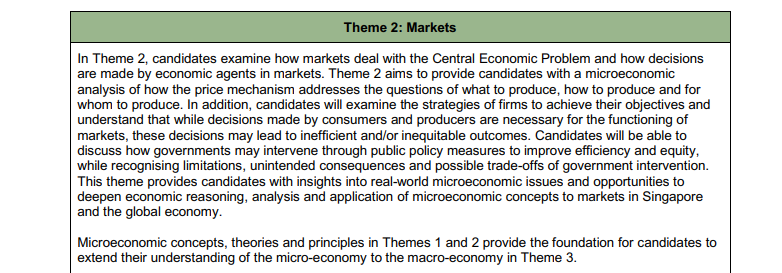


2.1.1 Price Mechanism and its Functions
2.1.1.a

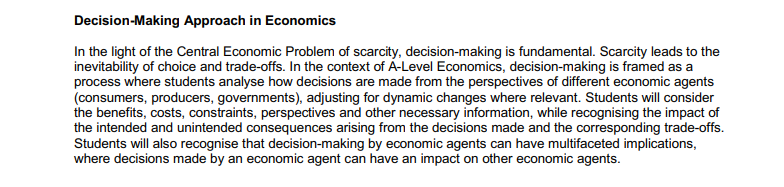
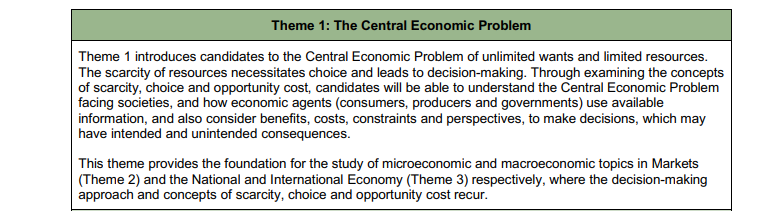
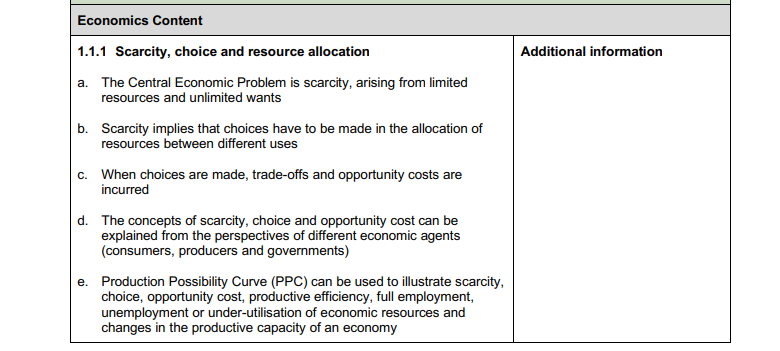
Central Economic Problem = scarcity
> How to allocate scarce resource?
  > price mechanism
    > signalling = what to produce?
    > incentive  = how to produce?
    > rationing  = for who to produce?
producer surplus = actual - willing_to_sell_for


P higher than P_equilibrium
 > price_mechanism__func01_signalling
   > high price signals demand is strong
 >
 > q_demanded is more than q_supplied
   > surplus (ie. too much, can't sell)
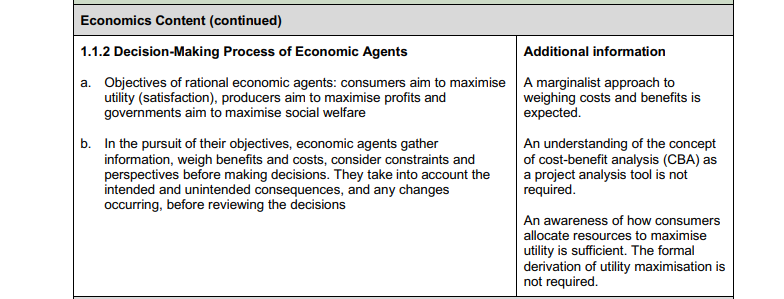
government goal max societal welfare
consumer   goal max utility
producer   goal max profit
Total Welfare
+-- Externalities
    +-- Pollution Taxes, Public Goods, etc..
+-- TS = Total Surplus
    +-- CS = Consumer Surplus = upper left triangle
    +-- PS = Producer Surplus = lower left triangle
CS = consumer surplus
   = upper left triangle
   = (left-to-right downward-sloping hypotenuse) - (base)
   = willing                                     - actual
   = budget                                      - actual

Demand Curve of Consumers
  if iPhone SGD 3,000.00, q_demanded = 0 ===> So expensive, nobody wants
  if iPhone SGD 1,000.00, q_demanded = 2000, q_supplied = 2000
                          market clears at the equilibrium price
The Upper-Left Triangle
  is formed by
  +-- vertical   = part of the y-axis or price-axis
  +-- base       = the horizontal line at the equilibrium price
  +-- hypotenuse = part of the left-to-right downward-sloping demand curve (line)

Consumer Surplus
  is the difference between
  +-- what the consumer is willing to pay, and
  +-- what the consumer actually paid, which is the equilibrium price in the market

  willing = (left-to-right downward-sloping hypotenuse) of the upper left triangle
          = drawn from (q=0, p=3k) to (q=50mm, p=1k)

  actual  = (base)                                      of the upper left triangle

  +-------------+----------------+-----------------+-----------------------+
  | Consumer_Id | Willing to Pay | Actual Paid     | CS = consumer surplus |
  |             | (budget)       | (p_equilibrium) | CS = Willing - Actual |
  +-------------+----------------+-----------------+-----------------------+
  |        ___1 |   SGD 2,999.00 |    SGD 1,000.00 |          SGD 1,999.00 |
  |        ___2 |   SGD 2,998.00 |    SGD 1,000.00 |          SGD 1,998.00 |
  |         ... |            ... |             ... |                   ... |
  |        1000 |   SGD 2,000.00 |    SGD 1,000.00 |          SGD 1,000.00 |
  |         ... |            ... |             ... |                   ... |
  |        2000 |   SGD 1,000.00 |    SGD 1,000.00 |          SGD _,__0.00 |
  +-------------+----------------+-----------------+-----------------------+
In Mathematics, y = f( x )
  y-axis = dependent factor
  x-axis = independent factor

In Economics, it is opposite when we look at Elasticity
  y-axis = price
  x-axis = quantity
Responsiveness
> consumer = d_q_demanded / q_demanded
> producer = d_q_supplied / q_supplied
The extent of change in (ss,dd) when these determinants change

When these determinants change
==> what is the extent of change in (ss,)
What are “these determinants”?

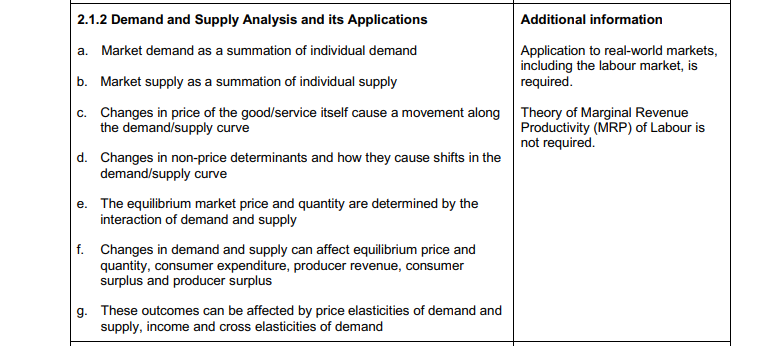
For demand (DD), the key non‑price determinants (shift‑factors) are:
 Income (for normal vs inferior goods)
 Prices of related goods (substitutes and complements)
 Tastes / preferences
 Expectations (about future prices, income, product availability)
 Number of buyers in the market

For supply (SS), the key non‑price determinants are:
 Input / factor prices (wages, raw‑material costs)
 Technology (more efficient production)
 Taxes and subsidies
 Prices of other goods (if firms can switch production)
 Producer expectations (about future prices)
 Number of sellers

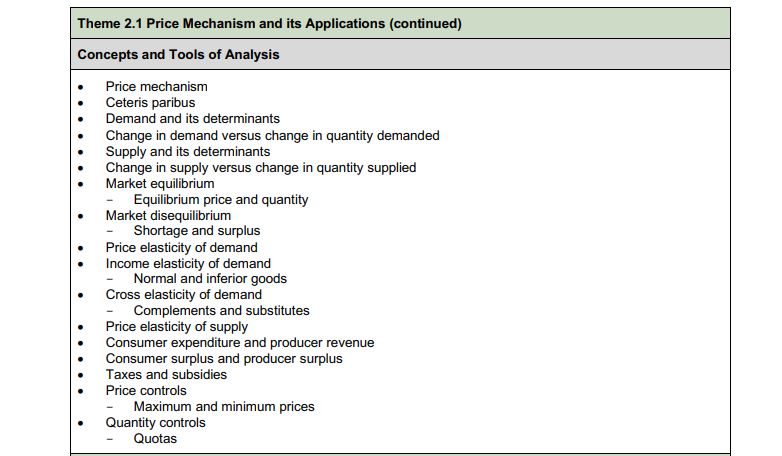
2.1.2.
The extent of change
Elasticity of demand and supply

Responsiveness of consumer ?
Responsiveness of producer ?