

20260228_001830_white=burgerlabobo(749)=accu(72.2)=game(1100)_black=XadrezDuArte(712)=accu(68.1)=game(900)
https://www.chess.com/game/live/165286232220?username=burgerlabobo

20260228_001830
_white=burgerlabobo(749)=accu(72.2)=game(1100)
_black=XadrezDuArte(712)=accu(68.1)=game(900)

[Event "Live Chess"]
[Site "Chess.com"]
[Date "2026.02.27"]
[Round "?"]
[White "burgerlabobo"]
[Black "XadrezDuArte"]
[Result "1-0"]
[TimeControl "1800"]
[WhiteElo "749"]
[BlackElo "712"]
[Termination "burgerlabobo won by resignation"]
[ECO "C42"]
[EndTime "16:18:30 GMT+0000"]
[Link "https://www.chess.com/game/live/165286232220?username=burgerlabobo&move=0"]

1. e4 e5 2. Nc3 Nf6 3. Nf3 Bc5 4. Bc4 d6 5. O-O Nc6 6. d3 Ng4 7. Bg5 f6 8. Bh4
g5 9. Bg3 Qe7 10. Nd5 Qd7 11. h3 Nh6 12. Nxf6+ Kf8 13. Nxd7+ Bxd7 14. Nxg5 Rg8
15. h4 Rg7 16. Qf3+ Ke7 17. Rae1 Nd4 18. Qd1 Rf8 19. Kh1 Bg4 20. f3 Bh5 21. c3
Nc6 22. Ne6 Rxg3 23. Nxf8 Kxf8 24. Qd2 Nf7 25. a3 Ne7 26. b4 Bb6 27. d4 Ng6 28.
dxe5 Ngxe5 29. Bxf7 Kxf7 30. Qd5+ Ke7 31. Qxb7 Nd3 32. Rd1 Nf4 33. Rxd6 Kxd6 34.
Rd1+ Ke7 35. e5 Rxg2 36. Qe4 Ne2 37. Kxg2 Nxc3 38. Qxh7+ Ke6 39. Re1 Be8 40.
Qh6+ Kf5 41. Qf8+ Kg6 42. Qxe8+ Kh6 43. e6 Nd5 44. e7 Nf4+ 45. Kh2 Bf2 46. Qf8+
1-0

You played a sharp Vienna Game
with a kingside attack that your opponent mishandled, and you converted well when material up.

### Opening (moves 1–6)

- 1. e4 e5 2. Nc3 is the Vienna; 3. Nf3 and 4. Bc4 are fine developing moves aiming at fast kingside play.
- 6. d3 is solid; you kept the center stable and were ready to castle, which you did quickly on move 5.

### Winning the early tactics (moves 6–16)

- Black’s 6…Ng4 7…f6 8…g5 exposed their king badly; your 7. Bg5 and 8. Bh4 kept pieces active and provoked weaknesses.
- 12. Nxf6+! followed by 13. Nxd7+ and 14. Nxg5 was the key sequence:
you won a pawn, wrecked Black’s kingside, and forced their king to stay in the center.
- After 16. Qf3+ Ke7 you had: safer king, better development, and a more active queen and rooks.

### Converting the advantage (moves 17–33)

- 17. Rae1 and 19. Kh1 were good practical moves: you brought a rook to the center and stepped your king off the g1–a7 diagonal.
- 22. Ne6! was strong, hitting g7 and f8; after you traded pieces and reached 24. Qd2 Nf7, you were clearly better in both activity and king safety.
- The critical moment: 31. Qxb7 won a pawn and started picking up Black’s queenside; then 33. Rxd6+! sacrificed the rook temporarily but led to winning material after 33…Kxd6 34. Rd1+.

### Endgame/technical phase (moves 34–46)

- After 35. e5 and 36. Qe4 you had a queen, rook, and passed pawn vs Black’s scattered pieces; your king was also safer.
- 43. e6, 44. e7 pushed the passer decisively; Black’s pieces had to defend and became overloaded, and 46. Qf8+ left Black with no good defense, leading to resignation.

### Main strengths

- You punished risky moves (…Ng4, …g5, …f6) instead of retreating passively.
- You developed quickly, castled early, and kept your pieces pointing at the enemy king.
- Once ahead, you kept trading and pushing your passed pawn, which is exactly what you should do.

### One simple improvement idea

In positions like after 20…Bh5, consider immediately increasing pressure on the enemy king (for example, quick central pawn breaks like f4 or e5 when safe) instead of giving Black extra tempi to reorganize. This can often lead to a faster attack at this level.

If you like, send me another of your recent games and I can compare where you attacked well versus where you missed tactics.
20260224_090625_white=gdf7777(849)=accu(56.4)=game(400)_black=burgerlabobo(779)=accu(57.0)=game(450)
https://www.chess.com/game/live/165121742952?username=burgerlabobo

20260224_090625
_white=gdf7777     (849)=accu(56.4)=game(400)
_black=burgerlabobo(779)=accu(57.0)=game(450)

[Event "Live Chess"]
[Site "Chess.com"]
[Date "2026.02.24"]
[Round "?"]
[White "gdf7777"]
[Black "burgerlabobo"]
[Result "0-1"]
[TimeControl "1800"]
[WhiteElo "849"]
[BlackElo "779"]
[Termination "burgerlabobo won by resignation"]
[ECO "C53"]
[EndTime "1:06:25 GMT+0000"]
[Link "https://www.chess.com/game/live/165121742952?username=burgerlabobo&move=0"]

1. e4 e5 2. Nf3 Nc6 3. Bc4 Bc5 4. c3 Nf6 5. d4 Bd6 6. Ng5 O-O 7. d5 Ne7 8. Qf3
Ng6 9. h4 h5 10. Be2 c6 11. dxc6 dxc6 12. Kf1 Bg4 13. Qd3 b5 14. Bxg4 Nxg4 15.
f3 Nf6 16. c4 a6 17. cxb5 axb5 18. a3 Ra4 19. Nc3 Rd4 20. Qc2 c5 21. Nxb5 Rxe4
22. fxe4 Ng4 23. Qd2 Qf6+ 24. Nf3 Bb8 25. Qc3 Qe7 26. Qc4 Rd8 27. Bg5 Ne3+ 28.
Bxe3 Nf4 29. Bxc5 Qf6 30. g3 Ne6 31. Qc3 Nxc5 32. Kg2 Nxe4 33. Qe3 Qf5 34. Rhf1
Qg4 35. Nxe5 Rd2+ 36. Kg1 Bxe5 37. Rad1 Rxd1 38. Rxd1 Bxg3 39. Rd8+ Kh7 40. Re8
Bf4+ 41. Kf1 Bxe3 0-1

You handled this game well
and converted cleanly after your opponent overextended in the opening and early middlegame.

Below is a brief move‑phase breakdown and a few concrete improvement points for you (Black, burgerlabobo).

## Opening (moves 1–8)

You played a standard Italian setup:
1. e4 e5 2. Nf3 Nc6 3. Bc4 Bc5 is all normal.
5…Bd6 is a bit unusual (…d6 or …0–0 is more common), because the bishop blocks your d‑pawn and is a bit clumsy.

Key moment:
6. Ng5 0–0! – castling is sensible and safe here.
After 7. d5 Ne7 8. Qf3 Ng6 9. h4 h5,
you’ve neutralized the kingside threat and White’s pieces start to look overextended.

**Takeaway:** In the Italian, prefer simple development:
…d6, …d6–…h6, …Re8, and only move the dark‑squared bishop to d6 if you have a clear reason.

## Early middlegame (moves 9–18)

From 10. Be2 c3 11. dxc6 dxc6, central tension resolves and White’s king stays in the center.
You have easier development.

Important sequence:
16…a6 17. cxb5 axb5 18. a3 Ra4 – you start active play on the queenside and put a rook on a strong 4th‑rank post.

Here, think in plans:
- Target the c4 bishop and central squares with moves like …Qb6, …Qb6–…Nf4.
- Open the center more only when your pieces are better placed than your opponent’s.

**Takeaway:** You did well to activate your rook with …Ra4; try to combine this with rapid development (…Be6, …Qb6, …Re8).

## Tactical phase (moves 19–32)

Critical turning point:
19. Nc3 Rd4 20. Qc2 c5 21. Nxb5 Rxe4!

Here 21…Rxe4 is a strong idea: you sacrifice the rook temporarily to open lines against White’s king and expose tactical weaknesses.
22. fxe4 Ng4 23. Qd2 Qf6+ – your queen joins the attack and White’s king is stuck in the center.

From here you correctly:
- Bring pieces with tempo: …Bb8, …Qe7, …Rd8.
- Keep pressure on the e4‑square and White’s king.

White’s 28. Bxe3 Nf4 29. Bxc5 Qf6 30. g3 Ne6 31. Qc3 Nxc5 32. Kg2 Nxe4 gives you an extra pawn and a huge attack.

**Takeaway:**
Excellent instinct to look for tactics with …Rxe4 and then rapidly add pieces to the attack.
Just always double‑check for simple refutations before sacrificing.

## Conversion (moves 33–41)

End sequence:
- 33. Qe3 Qf5 keeps pressure and hits both f2 and g3.
- 34. Rhf1 Qg4 maintains threats; you correctly avoid unnecessary exchanges.
- 35. Nxe5 Rd2+ 36. Kg1 Bxe5 picks up material with check.
- 37. Rad1 Rxd1 38. Rxd1 Bxg3 leaves you several pawns up with an ongoing attack.
- 40…Bf4+ 41. Kf1 Bxe3 finishes cleanly and White resigns in a completely lost position.

**Takeaway:** You did very well at:
- Trading when winning material (…Rxd1, …Bxg3, …Bxe3).
- Keeping your queen active around the enemy king rather than simplifying too early.

## 3 specific improvement tips

1. **Improve development in the Italian**
   - Replace 5…Bd6 with simple moves like 5…d6 or 5…0–0 so your pieces don’t block each other.

2. **Central breaks when the enemy king is stuck**
   - In similar positions, consider breaks like …c6 or …f5 when the enemy king is in the center, but only after you’ve completed development.

3. **Tactics training**
   - Your …Rxe4 idea shows good tactical vision;
     regular puzzles on themes like discovered attack, deflection, and clearance
     will sharpen this skill and make such ideas more precise.
20260223_161446_white=Routinier71(811)=accu(69.2)=game(950)_black=burgerlabobo(715)=accu(78.4)=game(1300)
https://www.chess.com/game/live/165085600272?username=burgerlabobo

20260223_161446
_white=Routinier71 (811)=accu(69.2)=game(950)
_black=burgerlabobo(715)=accu(78.4)=game(1300)

[Event "Live Chess"]
[Site "Chess.com"]
[Date "2026.02.23"]
[Round "?"]
[White "Routinier71"]
[Black "burgerlabobo"]
[Result "0-1"]
[TimeControl "1800"]
[WhiteElo "801"]
[BlackElo "725"]
[Termination "burgerlabobo won by checkmate"]
[ECO "C50"]
[EndTime "8:14:46 GMT+0000"]
[Link "https://www.chess.com/game/live/165085600272?username=burgerlabobo&move=0"]

1. e4 e5 2. Nf3 Nc6 3. Nc3 Nf6 4. Bc4 Bc5 5. d3 O-O 6. h3 d6 7. Be3 Bxe3 8. fxe3
Ne7 9. d4 Ng6 10. d5 a6 11. Qd2 b5 12. Bd3 Nh5 13. O-O-O Rb8 14. g4 Ng3 15. Rhg1
Nxe4 16. Bxe4 Qd7 17. Bf5 Qe8 18. e4 b4 19. b3 bxc3 20. Qxc3 Nf4 21. Bxc8 Ne2+
22. Kb2 Nxc3 23. Kxc3 Qxc8 24. Kb2 c6 25. dxc6 Qxc6 26. Rd5 Rbc8 27. Rc1 Qc3+
28. Kb1 Qxf3 29. Rd3 Qxe4 30. Rxd6 Rc6 31. Rdd1 a5 32. a4 Rb8 33. Rd2 Qxa4 34.
Rcd1 Rcc8 35. Kb2 g6 36. g5 e4 37. h4 Qe8 38. Re2 Qe5+ 39. Ka3 Qe7+ 40. Kb2 a4
41. Re3 a3+ 42. Ka2 Rxc2+ 43. Kb1 Rbc8 44. Ree1 Qa7 45. Rc1 a2+ 46. Ka1 Rxc1+
47. Rxc1 Rxc1+ 48. Kb2 a1=Q# 0-1

You played a very good attacking game and converted cleanly once you got the initiative.
Here are the key moments and practical lessons, focusing on what you did well and where you can tighten up further.

## Opening and early middlegame (moves 1–12)

1. e4 e5 2. Nf3 Nc6 3. Nc3 Nf6 4. Bc4 Bc5 5. d3 O-O 6. h3 d6 7. Be3 Bxe3 8. fxe3.

- As Black you reached a **Giuoco Piano**–type position (ECO C50) and castled quickly, which is good in 15+0.
- 7…Bxe3 8.fxe3 damages White’s kingside pawn structure and opens the f‑file, giving you clear long‑term targets.
  This is strategically sensible at your level.

Improvement idea:
After 8.fxe3, consider rapid central play like …Be6, …d5, or …Na5 hitting Bc4, instead of slow manoeuvring,
to punish his weakened king position even earlier.

## Seizing the initiative (moves 12–21)

12. Bd3 Nh5 13. O-O-O Rb8 14. g4 Ng3 15. Rhg1 Nxe4 16. Bxe4 Qd7 17. Bf5 Qe8 18. e4 b4 19. b3 bxc3 20. Qxc3 Nf4 21. Bxc8 Ne2+.

- …Nh5–g3 and then …Nxe4 was a nice tactical idea: you exploited his overextended kingside pawns and central tension.
- 18…b4! followed by …bxc3 caused serious problems for White’s king;
  you played on the correct side of the board (the queenside, where his king ended up).
- 20…Nf4!! is strong:
  you hit his bishop and threaten multiple tactics;
  21…Ne2+ is a pleasant fork tactic that picks up material and opens lines to his king.

Practical tip:
When your opponent castles long and you have a rook already on b8,
pushing …b4 and opening lines toward the king is exactly the right attacking plan. You executed that well.

## Transition to winning endgame (moves 22–33)

22. Kb2 Nxc3 23. Kxc3 Qxc8 24. Kb2 c6 25. dxc6 Qxc6
26. Rd5 Rbc8 27. Rc1 Qc3+ 28. Kb1 Qxf3 29. Rd3 Qxe4
30. Rxd6 Rc6 31. Rdd1 a5 32. a4 Rb8 33. Rd2 Qxa4.

- By move ~24 you are clearly winning: up material, better pieces, and a safer king.
- You did well to centralize your queen (…Qxc8, …Qxc6) and then bring rooks to open files (…Rbc8, …Rc6). This is a good endgame habit.
- 31…a5 and later …Qxa4 expanded your queenside advantage and collected more pawns without exposing your king.

Improvement idea:
At some points you could have simplified further—trading queens earlier into a rook endgame would also have been winning
and even easier to convert.
But your choice to keep pieces and attack was fine and worked.

## Converting the attack and checkmate (moves 33–48)

33. Rd2 Qxa4 34. Rcd1 Rcc8 35. Kb2 g6 36. g5 e4
37. h4 Qe8 38. Re2 Qe5+ 39. Ka3 Qe7+ 40. Kb2 a4
41. Re3 a3+ 42. Ka2 Rxc2+ 43. Kb1 Rbc8 44. Ree1 Qa7
45. Rc1 a2+ 46. Ka1 Rxc1+ 47. Rxc1 Rxc1+ 48. Kb2 a1=Q#.

- The final sequence is thematic:
  rook and queen on c‑ and b‑files, plus passed a‑pawn, trapping his king on the back rank.
- 41…a3!, 42…Rxc2+, 46…Rxc1+, and the final 48…a1=Q# form a clean mating net with your advanced pawn and active pieces.
- You avoided unnecessary checks and steadily improved your pieces while pushing the a‑pawn;
  that’s excellent technique.

Practical tip:
Pushing the passed pawn
only after your pieces are ideally placed (rooks on open files, queen active)
is a good model to follow in future games.

## Concrete improvement points for you

- Opening:
  - Learn a basic plan vs. Italian structures:
    after 3.Bc4, aim for …Bc5, …h6 or …a6, …d6, and at the right moment …Na5 or …d5 to challenge the bishop and center.
  - Try to avoid too many knight moves early (…Ng6–h5–g3) unless there’s a clear tactical point;
    in this game it worked, but often simpler development is safer.

- Tactics training:
  - You *saw* …Nxe4 and …Ne2+ in this game;
    reinforcing this with daily puzzles (especially forks, discovered attacks, and attacks on castled kings)
    will give you more games like this.
  - When the enemy king castles long, automatically check:
    “Can I push my rook pawn or b‑pawn to open lines?”
    You did that here with …b4, keep that pattern.

- Endgame conversion:
  - In winning positions, consider:
    “Can I trade queens into a simpler winning endgame?”
    That often reduces the chance of blunders when under time pressure.
20260222_140201_white=burgerlabobo(674)=accu(77.7)=game(1250)_black=bbgoyal(770)=accu(65.9)=game(650)
https://www.chess.com/game/live/165036675150?username=burgerlabobo

20260222_140201
_white=burgerlabobo(674)=accu(77.7)=game(1250)
_black=bbgoyal     (770)=accu(65.9)=game(650)

[Event "Live Chess"]
[Site "Chess.com"]
[Date "2026.02.22"]
[Round "?"]
[White "burgerlabobo"]
[Black "bbgoyal"]
[Result "1-0"]
[TimeControl "1800"]
[WhiteElo "684"]
[BlackElo "760"]
[Termination "burgerlabobo won by resignation"]
[ECO "C50"]
[EndTime "6:02:01 GMT+0000"]
[Link "https://www.chess.com/game/live/165036675150?username=burgerlabobo&move=0"]

1. e4 e5 2. Nf3 Nc6 3. Bc4 f6 4. O-O d6 5. d3 Bg4 6. h3 Bxf3 7. Qxf3 Qe7 8. Be3
O-O-O 9. Nc3 b6 10. Ba6+ Kb8 11. Nd5 Qf7 12. a4 Nge7 13. Ra3 Nxd5 14. exd5 Nb4
15. c3 Nxa6 16. Rb3 c5 17. a5 Qb7 18. axb6 axb6 19. c4 g5 20. Qxf6 Be7 21. Qe6
Nc7 22. Qxe7 h6 23. Ra1 Rde8 24. Qf6 Rh7 25. Qxd6 Kc8 26. Rxb6 Nb5 27. cxb5 Rd7
28. Qxc5+ Rc7 29. Qd6 Rd8 30. Qe6+ 1-0

You converted your lead into a win nicely after provoking …b6 and …Kb8; from there,
the queenside attack with Ba6+, Nd5, a4–a5, and Rb3–Rb1–Rb6 ideas was the right strategic direction against Black’s king.

## Opening (moves 1–8)

- 1. e4 e5 2. Nf3 Nc6 3. Bc4 enters an Italian/Guioco Piano type setup.
- 3…f6 is a weakening move because it:
  - Exposes the dark squares around Black’s king.
  - Blocks the natural development of the g8-knight.
- Your 4. O-O and 5. d3 are solid; they keep the position flexible and safe.
- 6. h3 is fine: it asks the bishop a question and avoids Bxf3 at an inconvenient time.
- 7. Qxf3 is okay, but 7. Qxf3 already places the queen actively and keeps your structure intact.

Small improvement: instead of 8. Be3?! immediately, 8. Nc3 or 8. c3 followed by d4 is more principled, fighting for the center before spending time on a bishop move.

## Exploiting the queenside (moves 9–18)

- 8…O-O-O 9. Nc3 b6 10. Ba6+ Kb8 is excellent play by you: Ba6+ forces Black’s king further into danger and highlights …b6 as a weakening move.
- 11. Nd5! is strong: you jump into an outpost, hit f6 and c7, and increase pressure.
- 12. a4 is thematic, preparing a5 and opening lines against the king. Well done.
- 13…Nxd5 14. exd5 Nb4 15. c3 Nxa6: Black wins a pawn, but your compensation is big:
  - Better development.
  - Open lines on a- and b-files.
  - Black king safety is very shaky.
- 16. Rb3! is a good attacking idea, aiming at b6 and swinging the rook across later.

Your sequence 17. a5, 18. axb6, 19. c4 shows good attacking instinct: open the a- and b-files and keep your rook active.

## Tactics and conversion (moves 19–30)

Critical phase starts with 20. Qxf6:
- You correctly grab the f6 pawn; Black has no immediate counterattack.
- 21. Qe6 keeps pressure and eyes e5 and c6.

Big tactical moment:
- 21…Nc7? 22. Qxe7 wins a clean pawn and keeps the attack; you also hit c5 in some lines.
- After 23. Ra1, 24. Qf6, 25. Qxd6, you’re up material and your pieces dominate the open files.

Nice technique at the end:
- 26. Rxb6! removes a key defender and opens the b-file.
- 28. Qxc5+ and 29. Qd6 force Black’s pieces into passive defense and keep their king in the center.
- 30. Qe6+ leaves Black with no good defense, and resignation is justified.

## What you did well

- Castled early and kept your king safe.
- Chose the correct side to attack (queenside) once Black castled long and weakened with …b6 and …Kb8.
- Used pieces harmoniously: Ba6+, Nd5, Rb3, a4–a5, Qxf6, and Ra1 all fit the same plan.
- Converted material and positional advantage without allowing counterplay.

## Simple improvements to work on

- In the opening, develop pieces and fight the center before moving the same piece multiple times
  (e.g., consider Nc3 or c3 + d4 earlier instead of quick Be3).
- Before allowing captures like …Nxa6, always ask: “What do I get in return?”
  Here you had compensation, but it’s a good habit to double-check.
- When ahead in development with an unsafe enemy king,
  actively calculate forcing moves:
  sacrifices on b6 or c5 could sometimes lead to quicker mates or decisive material wins.

If you like, next time I can go move by move
and point out specific candidate moves you missed and some mating ideas in similar opposite-side castling positions.
20260221_164143_white=burgerlabobo(671)=accu(62.0)=game(650)_black=AnatolyIvanovichAndreev(747)=accu(51.9)=game(200)
https://www.chess.com/game/live/164995244798?username=burgerlabobo

20260221_164143
_white=burgerlabobo           (671)=accu(62.0)=game(650)
_black=AnatolyIvanovichAndreev(747)=accu(51.9)=game(200)

[Event "Live Chess"]
[Site "Chess.com"]
[Date "2026.02.21"]
[Round "?"]
[White "burgerlabobo"]
[Black "AnatolyIvanovichAndreev"]
[Result "1-0"]
[TimeControl "1800"]
[WhiteElo "681"]
[BlackElo "737"]
[Termination "burgerlabobo won by resignation"]
[ECO "B00"]
[EndTime "8:41:43 GMT+0000"]
[Link "https://www.chess.com/game/live/164995244798?username=burgerlabobo&move=0"]

1. e4 b6 2. Nc3 Bb7 3. Bc4 e6 4. Qf3 Nf6 5. Nge2 h6 6. d3 Bb4 7. a3 Bxc3+ 8.
Nxc3 Nc6 9. Be3 Na5 10. b4 Nxc4 11. dxc4 a6 12. O-O a5 13. Rad1 axb4 14. axb4
Ra3 15. Rd3 d6 16. Bc1 Ra7 17. Qe2 Qa8 18. Rfd1 O-O 19. e5 Ne8 20. Rg3 Qc8 21.
Ne4 dxe5 22. Bxh6 Ra4 23. Bxg7 Nxg7 24. Nf6+ 1-0

A very nice attacking win for you as White against Owen’s Defence (1…b6).

## Opening (moves 1–6)

1. e4 b6 2. Nc3 Bb7 3. Bc4 e6 4. Qf3 Nf6 5. Nge2 h6 6. d3

What you did well:
- 1. e4 and 2. Nc3 are fine, you took the center and developed quickly.
- 3. Bc4 aims at f7 and is a common idea at your level.

What to improve:
- 4. Qf3 brings the queen out too early and can get hit by pieces; stronger is simple development like Nf3 or d4.
- 5. Nge2 blocks your c1 bishop and makes it harder to play d4 later; usually the king knight goes to f3 in these structures.

Simple rule here:
in the opening, prefer knights and bishops before the queen, and try not to block your own bishops.

## Early middlegame (moves 7–13)

7. a3 Bxc3+ 8. Nxc3 Nc6 9. Be3 Na5 10. b4 Nxc4 11. dxc4 a6 12. O-O a5 13. Rad1

What you did well:
- 8. Nxc3 recaptures with development, good.
- 12. O-O is excellent: you castle on time and make your king safe.
- 13. Rad1 centralizes a rook to the d‑file, which is exactly what you want in this kind of position.

What to improve:
- 7. a3 is a bit slow;
  a move like 7. O-O or 7. Bd2 develops or improves your position more directly.
- 10. b4 gains space but also weakens your queenside; it’s playable, but at your rating it’s safer to finish development first.

Rule of thumb:
when in doubt, develop a new piece or improve a central piece rather than pushing side pawns.

## Critical phase (moves 14–21)

14. axb4 Ra3 15. Rd3 d6 16. Bc1 Ra7 17. Qe2 Qa8 18. Rfd1 O-O 19. e5 Ne8 20. Rg3 Qc8 21. Ne4

What you did well:
- 14. axb4 recaptures calmly and keeps the structure together.
- 15. Rd3 and 18. Rfd1 double rooks on the d‑file and show a good idea of coordinating your pieces.
- 19. e5 is a strong attacking move, gaining space and pushing at the knight on f6.

What to improve:
- 16. Bc1 is a bit passive;
  more active is 16. Rg3 immediately or 16. Rfd1 to keep pressure.
- 20. Rg3 is good because it swings toward the king, but make sure you also check if your back rank and pieces are safe.

Key idea here:
your rooks are well placed and you correctly start an attack with e5 and Rg3 once you are mostly developed.

## Winning sequence (moves 22–24)

22. Bxh6 Ra4 23. Bxg7 Nxg7 24. Nf6+ 1-0

Excellent finish:
- 22. Bxh6 sacrifices the bishop to open the king and exploit the g‑ and h‑files.
- 23. Bxg7 removes a key defender of the king (the knight on g7 after recapture), which is a classic attacking idea.
- 24. Nf6+ is a powerful check that wins material and leaves Black’s king in big trouble, which is why your opponent resigned.

This is a great example of opening lines against the king and using all your attacking pieces together (queen, rook, knight, bishop).

## Concrete improvement plan

Focus on three habits:

- Opening:
  - Develop both knights and both bishops before moving the queen.
  - Castle by move 10 in most games.

- Piece activity:
  - Avoid blocking your own bishops (e.g., Nge2 in front of the c1 bishop).
  - When you’re ahead in development, think about pawn breaks like e5 to open lines.

- Attacking the king:
  - Open lines around the king with sacrifices only when you have several pieces ready to join the attack (like in this game).
20260221_130220_white=burgerlabobo(654)=accu(71.5)=game(1000)_black=payamoni(650)=accu(52.9)=game(250)
https://www.chess.com/game/live/164989811594?username=burgerlabobo

20260221_130220
_white=burgerlabobo(654)=accu(71.5)=game(1000)
_black=payamoni    (650)=accu(52.9)=game(250)

[Event "Live Chess"]
[Site "Chess.com"]
[Date "2026.02.21"]
[Round "?"]
[White "burgerlabobo"]
[Black "payamoni"]
[Result "1-0"]
[TimeControl "1800"]
[WhiteElo "670"]
[BlackElo "654"]
[Termination "burgerlabobo won by checkmate"]
[ECO "C26"]
[EndTime "5:02:20 GMT+0000"]
[Link "https://www.chess.com/game/live/164989811594?username=burgerlabobo&move=0"]

1. e4 e5 2. Nc3 Nf6 3. Bc4 Bc5 4. Nf3 Nc6 5. O-O O-O 6. Ng5 Qe8 7. Qf3 d6 8. d3
Nd4 9. Qg3 Nh5 10. Qh4 g6 11. Be3 Nxc2 12. Rac1 Nxe3 13. fxe3 Bxe3+ 14. Kh1 Bxc1
15. Bxf7+ Rxf7 16. Nxf7 Be6 17. Nh6+ Kh8 18. Rxc1 Qd8 19. Qf2 Nf4 20. Nd5 Nxd3
21. Nf7+ Bxf7 22. Qxf7 Nxc1 23. Nf6 Qg8 24. Nxg8 Ne2 25. Nf6 Nf4 26. Qxh7# 1-0

You played a very energetic attacking game and punished Black’s mistakes nicely,
especially with your knights and queen.

## Opening (moves 1–6)

1. e4 e5 2. Nc3 Nf6 3. Bc4 Bc5 4. Nf3 Nc6 5. O-O O-O
is a normal Vienna Game setup; your development and castling are excellent here.

6. Ng5?! already goes for tactics on f7,
but here Black can simply play …h6 or …d6 and be fine,
so this move is a bit optimistic.

A safer improvement is
6. d3 or 6. h3, calmly finishing development and keeping the **position** solid.

## Early middlegame tactics (moves 7–15)

7. Qf3?! brings the queen out early;
at your level this can work, but it also risks getting your queen chased and losing time.

8. d3 is good, supporting the center and opening your dark‑square bishop.

9. Qg3 10. Qh4 shows “queen wandering”;
each queen move gives Black chances to gain time by attacking it.

11. Be3? walks into …Nxc2 and …Bxe3;
here 11. g4 or 11. Kh1 keeping your pieces coordinated would be safer.
Despite that, Black’s 11…Nxc2 12…Nxe3 13…Bxe3+ allows you strong counterplay on the f‑file and dark squares.
15. Bxf7+! is a nice sacrifice: you open the king, drag the rook off f8, and activate your knight with tempo.

## Conversion of the attack (moves 16–23)

16. Nxf7! is excellent; you fork the queen and rook and keep Black’s king exposed.
17. Nh6+ is also good, driving the king to h8 where it is very unsafe.
18. Rxc1 trades off their active bishop and brings your rook to the open c‑file;
    that’s a strong practical decision.
19. Qf2 centralizes the queen and eyes f8 and g8; good choice to regroup instead of forcing things.

20. Nd5! is a powerful move, jumping into the center and attacking f4 and c7; you also threaten Nf7+ ideas.
Even though Black grabs material with …Nxd3 and …Nxc1, their king is too exposed and your pieces are much more active.

## Finishing blow (moves 23–26)

23. Nf6! is a strong attacking move,
increasing pressure on g8 and h7 and coordinating knight and queen.
24. Nxg8! removes the best defender of the back rank and dark squares around Black’s king.

25. Nf6 keeps the mating net, threatening Qxh7# or Qg8#, and Black’s …Nf4 fails to create real counterplay.
26. Qxh7# is a clean checkmate and a nice reward for your earlier piece sacrifices.

## What you did well

- Fast development and early castling gave you a safe king and active pieces.
- The sacrifices Bxf7+ and Nxf7 showed good attacking instinct against the king.
- You brought more pieces into the attack (knights, queen, rook) instead of trying to win material back immediately.

## Main things to improve

- Avoid moving the **queen** too many times in the opening (Qf3–Qg3–Qh4–Qf2);
  develop knights and bishops first.
- Before playing aggressive moves like Be3, quickly check:
  “What can their piece capture if I move here?” to avoid walking into simple tactics.
- When you see a sacrifice like Bxf7+, always ask:
  “If they decline or defend well, do I still have enough pieces attacking?”—here it worked, but building that habit will help.
20260220_172540_white=Krishna-Sumeet(681)=accu(62.8)=game(250)_black=burgerlabobo(650)=accu(56.6)=game(600)
https://www.chess.com/game/live/164948952856?username=burgerlabobo

20260220_172540
_white=Krishna-Sumeet(681)=accu(62.8)=game(250)
_black=burgerlabobo  (650)=accu(56.6)=game(600)

[Event "Live Chess"]
[Site "Chess.com"]
[Date "2026.02.20"]
[Round "?"]
[White "Krishna-Sumeet"]
[Black "burgerlabobo"]
[Result "0-1"]
[TimeControl "1800"]
[WhiteElo "681"]
[BlackElo "650"]
[Termination "burgerlabobo won by resignation"]
[ECO "D00"]
[EndTime "9:25:40 GMT+0000"]
[Link "https://www.chess.com/game/live/164948952856?username=burgerlabobo&move=0"]

1. d4 d5 2. e3 c6 3. c3 Bf5 4. Nd2 Nd7 5. Qf3 g6 6. b4 e6 7. b5 Bd6 8. a4 Ngf6
9. a5 b6 10. Qd1 c5 11. axb6 Qxb6 12. Ra6 Qb8 13. Qa4 O-O 14. b6 Nxb6 15. Qa2 c4
16. Ba3 Ne8 17. Bxd6 Qxd6 18. Rxa7 Nc7 19. Ngf3 Nb5 20. Rxa8 Nxa8 21. Qb2 Qa6
22. Be2 Nac7 23. O-O Bd3 24. Bxd3 cxd3 25. Ra1 Qd6 26. c4 dxc4 27. Nxc4 Qd5 28.
Qb4 Qc6 29. Nfe5 Nd5 30. Qb3 Qb7 31. Nxd3 Ra8 32. Rxa8+ Qxa8 33. Kf1 Nbc3 34. e4
Qa1+ 35. Ne1 Nxe4 36. Qd3 Ndc3 37. g4 Qa2 38. Nc2 f5 39. f3 Qb1+ 40. Kg2 Nd5 41.
Nd2 Qb8 42. fxe4 Nf4+ 43. Kf3 Nxd3 44. exf5 Qb7+ 45. Ke3 Qa6 46. fxe6 Qxe6+ 47.
Kxd3 Qxg4 48. Nb4 Qh3+ 49. Kc4 Qxh2 50. Nb3 Qc7+ 51. Kd3 g5 52. d5 g4 53. Kd4 g3
54. Nc5 g2 55. Ne6 g1=Q+ 56. Ke4 Qc4+ 57. Ke5 Qxb4 58. d6 Qge1+ 59. Kd5 Qd1+ 60.
Ke5 Qbxd6+ 0-1


You played creatively and reached a winning middlegame with strong queenside play and piece activity,
but later drifted in a queen‑and‑pawns endgame where calculation and king safety became critical.

## Opening and early middlegame (moves 1–15)

- 3…Bf5 and 6…e6 are fine, but 5…g6 is slow and loosens your dark squares; a simple 5…e6 or 5…Ngf6 was safer.
- After 9.a5 b6 10.Qd1 c5 you correctly challenge the center and prepare pressure on c4/d4.
- 14…Nxb6 accepts structural damage (a weak c5 pawn and open a‑file) but keeps material balance;
  objectively OK, but you must be ready for pressure along a‑ and b‑files.

Example:
Instead of 10…c5 right away,
10…c5 after first completing development with …Nbd7 and …0‑0
would leave you better prepared for the coming queenside exchanges.

## Transition to advantage (moves 16–30)

- 16…Ne8 and 18…Qxd6 are accurate: you regroup and keep central control.
- 19…Nb5 20…Nxa8 is clever material grabbing, but your knight on a8 becomes very passive,
  so you must play very energetically in the center to compensate.
- 24…d3 is ambitious, creating a dangerous passed pawn supported by your pieces, which is thematically strong.
- After 26.c4 dxc4 27.Nxc4 Qd5 28.Qb4 Qc6 29.Nfe5 Nd5 you have a pleasant position: active queen, passed d‑pawn earlier,
  and White’s king still in the center.

Critical point:
around moves 24–29 you had the chance to improve pieces (…Rc8, …Qc7, …a5)
rather than rushing pawn exchanges;
smoother coordination would have increased your advantage.

## Queenside simplification and queen ending (moves 31–40)

- 31…Ra8 trades rooks, heading for a queen‑and‑pawns endgame where your king is slightly less safe;
  consider keeping one rook with …Qb8 or …Qc7 to maintain pressure.
- After 33.Kf1 Nbc3 34.e4 Qa1+ 35.Ne1 Nxe4 36.Qd3 Ndc3 you are still fine
  but must watch for perpetuals and checks once queenside pawns disappear.
- 38…f5 is double‑edged:
  it gains space but weakens dark squares around your king; in queen endings, king safety and pawn structure outweigh small space gains.

Example improvement:
Instead of 38…f5,
a move like …Qa6+ or …Qa8 keeping checks on the white king while not weakening your own king’s cover would have been safer.

## Critical endgame phase (moves 41–60)

This is where the result slips.

- 41…Qb8 is active,
  but 42.fxe4 Nf4+ (forked white's queen)
  43.Kf3 Nxd3 44.exf5 Qb7+ 45.Ke3 Qa6 46.fxe6 Qxe6+
  keeps queens on with an exposed king and passed f‑pawn for White.
- After 47.Kxd3 Qxg4 48.Nb4 Qh3+ 49.Kc4 Qxh2 50.Nb3 Qc7+ 51.Kd3 g5
  you choose a pawn race, but your king is more exposed and queens on board favor the side with safer king.
- From 52…g4 53.Kd4 g3 54.Nc5 g2 55.Ne6 g1=Q+ 56.Ke4 Qc4+ 57.Ke5 Qxb4 58.d6 Qge1+ 59.Kd5 Qd1+ 60.Ke5 Qbxd6+
  you are lost: your promoted queen cannot coordinate with your exposed king against White’s central passer and checks.

Key endgame mistakes:
- Allowing White’s king to become very active (Kc4–d4–e4–e5) while your own king stays on the back rank,
  against general endgame principles.
- Entering a pawn race without verifying the final position:
  when both sides promote, the side with the safer king often wins, even if promotion times are similar.

## Practical lessons and takeaways

- In the opening, avoid unnecessary pawn moves like …g6 when already committed to a solid …e6 structure;
  prioritize development and king safety.
- When you win material (…Nxa8), immediately plan to activate that piece or compensate with central activity;
  don’t let it stay out of play.
- In queen endings, value king safety and pawn structure more than small gains in space or tempo;
  think “can I safely approach with my king?” before starting a pawn race.
- Before pushing a passed pawn in a race,
  count the promotion moves for both sides and consider check patterns after promotion, not just who queens first.
20260219_153700_white=pramod2639srivastava(645)=accu(81.7)=game(1300)_black=burgerlabobo(649)=accu(81.4)=game(1250)
https://www.chess.com/game/live/164900539136?username=burgerlabobo

20260219_153700
_white=pramod2639srivastava(645) =accu(81.7) =game(1300)
_black=burgerlabobo        (649) =accu(81.4) =game(1250)

[Event "Live Chess"]
[Site "Chess.com"]
[Date "2026.02.19"]
[Round "?"]
[White "pramod2639srivastava"]
[Black "burgerlabobo"]
[Result "0-1"]
[TimeControl "1800"]
[WhiteElo "645"]
[BlackElo "649"]
[Termination "burgerlabobo won by checkmate"]
[ECO "C44"]
[EndTime "7:51:19 GMT+0000"]
[Link "https://www.chess.com/game/live/164900539136?username=burgerlabobo&move=0"]

1. e4 e5 2. Nf3 Nc6 3. g3 Bc5 4. Bg2 Bxf2+ 5. Kxf2 Nd4 6. Nxd4 exd4 7. Rf1 Qf6+
8. Kg1 Qb6 9. d3 Nf6 10. Na3 d6 11. Nc4 Qc5 12. a3 Bg4 13. Qe1 d5 14. exd5+ Kf8
15. b4 Re8 16. bxc5 Rxe1 17. Rxe1 g5 18. h3 Bd7 19. a4 h5 20. Ba3 Nxd5 21. Bxd5
Bxh3 22. Bxb7 h4 23. c6+ Kg7 24. Ne3 hxg3 25. Nd5 Bg4 26. Nxc7 Bf3 27. Bb2 Rh1#
0-1

Experiment: Sacrifice a Bishop Early
You played an unsound sacrifice,
then defended resourcefully and
finally won with a classic rook‑and‑bishop mate pattern;
the big lesson is to avoid speculative sacs without concrete follow‑up.
[chessfox](https://chessfox.com/checkmate-patterns/)

## Opening and early sacrifice (4…Bxf2+?)
Line: 1.e4 e5 2.Nf3 Nc6 3.g3 Bc5 4.Bg2 Bxf2+ 5.Kxf2 Nd4 6.Nxd4 exd4.
- The bishop sacrifice on f2/f7 is only correct in very specific positions
  where you have fast development and clear attacking lines;
  otherwise it is objectively bad.
  [adventuresofachessnoob](https://adventuresofachessnoob.com/2022/09/10/win-and-lose-with-the-bishop-sacrifice-gambit/)
- Here you give up a whole piece for a couple of pawns and a check or two,
  but your pieces are not yet developed
  and your queen/rook do not have decisive access to the enemy king,
  so with best play you should be worse.

As a training goal,
try to only sacrifice in the opening when
(a) you can calculate a concrete winning or perpetual line, or
(b) you know the theory well.

## Middlegame: compensation and practical chances

After
7.Rf1 Qf6+ 8.Kg1 Qb6 9.d3 Nf6 10.Na3 d6
11.Nc4 Qc5 12.a3 Bg4 13.Qe1 d5 14.exd5+ Kf8
you have:
two pawns for a piece, active bishops,
and some pressure on d5/f3,
but no direct mating attack.

- Strategically, you should aim for:
  - Rapid development (…Re8, …Kg7, rooks to e8/d8),
  - Opening lines where your piece activity might compensate for the material,
  - Keeping queens on to maintain practical chances.
- Moves like …d5 and …g5, …h5
  show you did manage to unsettle White and
  push for play on the kingside and center.

This is a good example of “swindling” with activity:
even from a worse position,
you kept pieces on and created threats.

## Conversion phase: building the mating net

After
19.a4 h5 20.Ba3 Nxd5 21.Bxd5 Bxh3 22.Bxb7 h4
23.c6+ Kg7 24.Ne3 hxg3 25.Nd5 Bg4 26.Nxc7 Bf3
you suddenly have strong attacking chances.

- Your rook on h8, bishop on g4–f3 and advanced g/h‑pawns coordinate well;
  White’s king is quite boxed in and his back rank is weak.
- 26…Bf3! is a powerful move, threatening …Rh1+ ideas
  by tying the bishop to the defence of h1 and
  keeping your rook ready to invade.

This phase demonstrates how active pieces and threats against the king
can compensate for earlier material investment when the opponent is careless.

## The finish: Rh1# and pattern

After
26.Nxc7? Bf3 27.Bb2 Rh1#
you deliver a textbook rook‑and‑bishop mate on the back rank.

- The pattern is essentially a Greco‑style mate:
  a rook delivers mate on the back rank
  while a bishop covers the king’s escape squares,
  and the king is trapped by its own pawns.
  [nscfchess](https://nscfchess.org/checkmating-patterns-rook-bishop/)
- Here, your rook on h1 is supported by the bishop on f3,
  and White’s king is blocked by its own pieces/pawns,
  so there is no escape.

This is a classic tactical pattern worth remembering;
it often arises when the defending side neglects back‑rank safety
and allows a rook invasion supported by a long‑range piece.
[chesstactics](https://www.chesstactics.org/mating-patterns/the-back-rank-mate/introduction_simple-cases/6_1_1_1.html)

## What to take away as Black

- Opening choice:
  4…Bxf2+ is not sound objectively;
  against stronger opposition you will often just be
  a piece down with insufficient attack.
  [lichess](https://lichess.org/forum/general-chess-discussion/what-to-do-when-opponent-unsoundly-sacrifice-on-f7f2)
- Practical play:
  You did well to keep creating threats and
  push pawns to open files around the enemy king
  rather than quietly accepting a lost endgame.
- Pattern training:
  Study bishop‑plus‑rook mates (Greco’s mate and similar) and back‑rank motifs;
  your final …Rh1# is exactly the kind of pattern
  that will get you many wins when opponents relax.
  [nscfchess](https://nscfchess.org/checkmating-patterns-rook-bishop/)
20260218_124500_white=Svenuk(600)=1000_black=burgerlabobo(652)=1300
1. e4 e5
2. Nf3 Nc6
3. Bc4 Nf6
4. d3 Bc5
5. c3 Ng4
6. d4 exd4
7. cxd4 Nxd4
8. Nxd4 Nxf2
9. Bxf7+ Kxf7
10. Qf3+ Qf6
11. Qxf6+ gxf6
12. O-O Bxd4
13. Nc3 Rg8
14. Bf4 Nh3+
15. Kh1 Nf2+
16. Kg1 Nxe4+
17. Kh1 Nf2+
18. Kg1 d6
19. Rxf2 Bxf2+
20. Kxf2 b6
21. Nb5 Bb7
22. Nxc7 Rxg2+
23. Kf1 Rc8
24. Bxd6 Rxb2
25. Re1 Rxa2
26. Re7+ Kg6
27. Re3 Rd8
28. Rg3+ Kf7
29. Bf4 Rd1# 0-1
You played a sharp Italian Game
and punished White’s early mistakes with tactics,
but you also took some unnecessary risks
in the opening and middlegame.
Here are the key moments and what to learn from them.

***

## Opening (moves 1–6)
1. e4 e5 2. Nf3 Nc6 3. Bc4 Nf6 4. d3 Bc5 5. c3 Ng4
- 5…Ng4 is playable but **risky** at your level,
  because the knight can get chased
  and you rely on tactics working perfectly.
  Stronger and easier plans are 5…d6 or 5…0‑0,
  just developing and keeping your king safe.
  [en.wikipedia](https://en.wikipedia.org/wiki/Italian_Game)
- After 6.d4 you correctly took:
  6…exd4, which challenges the center.
  That’s good opening play:
  fight the center with pawns, develop pieces, castle.

What to improve:
- Prefer simple development:
  5…0‑0, 6…d6, …h6, …Re8
  is a more “coach-approved” plan in the Italian for Black.
  [chess-teacher](https://chess-teacher.com/italian-game-black/)

***

## Big tactical moment 1: 8…Nxf2
Position after: 6. d4 exd4 7. cxd4 Nxd4 8. Nxd4
You played 8…Nxf2!?, entering a classic sacrifice on f2.
- This is a **double‑edged** idea:
  you grab a pawn, drag the king out,
  but if you misplay even one move, you’re just a piece down.
  At 600–650, it’s usually better to
  avoid such speculative sacs unless you know a concrete line.
- Objectively, White can defend better
  (for example, accurate king moves and not opening more lines),
  but your opponent didn’t.
  That means the sacrifice “worked” in this game,
  but it was more luck than sound theory.

Takeaway:
- Before sacrificing, ask: “After the sacrifice, do I get:
  (1) checkmate attack,
  (2) material back, or
  (3) a clearly winning endgame?”
  If the answer is “not sure,” don’t sac.

***

## Big tactical moment 2: 10…Qf6
After: 8. Nxd4 Nxf2 9. Bxf7+ Kxf7 10. Qf3+
You played 10…Qf6 11.Qxf6+ gxf6.
- You found a **practical** defence:
  you offer queens, trade, and run your king away from danger.
  If instead you had tried to keep queens on with something like 10…Kg8?!,
  your king would stay in the center and White’s attack might become very strong.
- After the trade,
  the structure is ugly (doubled f‑pawns, king in the center),
  but White has already spent a lot of material and tempi on the attack,
  and your pieces are quite active.

Takeaway:
- When under attack,
  trading queens
  is often a good defensive resource
  if it doesn’t lose material or mate.

***

## Middlegame turning point: 12…Bxd4 and 16…Nxe4
12. O-O Bxd4 13. Nc3 Rg8 14. Bf4 Nh3+ 15. Kh1 Nf2+ 16. Kg1 Nxe4+
- 12…Bxd4 is fine:
  you remove a centralized piece and simplify.
- 13…Rg8 puts your rook on an open file towards the king.
  Good attacking instinct.
- 14…Nh3+ 15.Kh1 Nf2+ 16.Kg1 Nxe4+
  shows a chain of forcing moves (checks and a capture).
  You are playing actively and using tactics,
  which is exactly how you should justify your earlier sacrifice.

However:
- 16…Nxe4+ again increases your material investment in the attack.
  If you miscalculate, you end up just down material.
  You got away with it
  because White didn’t find defensive resources.

Training idea:
- Practice “blunder checking”:
  before playing a forcing move like …Nxe4+,
  quickly ask “What is my opponent’s best reply?
  Do I lose any piece in one move?”

***

## Converting the advantage (moves 18–28)
18. Kg1 d6 19. Rxf2 Bxf2+ 20. Kxf2 b6 21. Nb5 Bb7
22. Nxc7 Rxg2+ 23. Kf1 Rc8 24. Bxd6 Rxb2 25. Re1 Rxa2
Key points here:
- 18…d6 is good:
  you finally support your center and free your pieces.
- White blunders with 19.Rxf2?,
  giving you back material with interest:
  19…Bxf2+ and your attack continues.
- You pick up pawns (…Rxb2, …Rxa2)
  and your rook becomes very active on the second rank.
  This is good practical play:
  when ahead, take safe pawns and improve piece activity.

Things to clean up:
- Your king is still a bit exposed; at some point,
  a move like …Kg6 or …Kf7 (which you did)
  is useful to connect rooks and avoid back‑rank tricks.

***

## Finish: the mating net
25. Re1 Rxa2 26. Re7+ Kg6 27. Re3 Rd8 28. Rg3+ Kf7 29. Bf4 Rd1#
- The final sequence is **very nice**.
  The idea:
  - …Rd8 activates the rook on an open file.
  - …Kf7 walks the king out of checks
    and also supports the rook’s invasion.
  - 29…Rd1# uses the back rank
    and your rook plus bishop coordination to deliver mate.
- This is a textbook example
  of punishing a weak back rank and an exposed king.

Takeaway:
- You correctly focused on activity and coordination:
  rook on the open file, bishop pointing at the king,
  king stepping away from checks.
  That’s exactly the right instinct.

***

## Concrete improvement tips for you (Black, 600–700 level)

1. Opening priorities in the Italian as Black
   - Develop all minor pieces
     (…Nc6, …Nf6, …Bc5 or …Be7, …d6),
     then castle.
   - Only go for early knight jumps
     like …Ng4 or sacrifices
     if you know the line,
     otherwise prefer calm development.

2. Before sacrificing material
   - Count: “I give up a knight = 3 points; what do I get?”
   - Look for a **forced line**
     (checks, captures, threats) that leads to clear gain.
     If you can’t see it, keep the piece.

3. Defensive habits
   - When attacked, always check if trading queens helps you.
   - Ask at every move: “Is anything of mine hanging?”
     Look for one‑move tactics against your pieces and king.

4. Endgame and conversion
   - When ahead in material:
     trade pieces, not pawns
     (simplify the position, keep enough pawns to win).
   - Activate your king in the endgame and your rooks on open files.
20260216_215700_white=burgerlabobo(608)-black=diogenesOne(600)
1. e4 e5
2. Nc3 Nf6
3. Nf3 Nc6
4. Bc4 h6
5. a4 a5
6. O-O d6
7. d3 Bd7
8. Ne1 Nd4
9. Be3 Bg4
10. f3 Bd7
11. Ne2 Ne6
12. c3 c5
13. b3 b6
14. d4 cxd4
15. cxd4 exd4
16. Nxd4 Be7
17. Nf5 Rc8
18. Rc1 O-O
19. Qd2 Nc5
20. Bxh6 Bxf5
21. exf5 gxh6
22. Qxh6 Ne6
23. fxe6 fxe6
24. Bxe6+ Rf7
25. Bxc8 Qf8
26. Qg5+ Rg7
27. Be6+ Kh8
28. Qh4+ Rh7
29. Qd4 Qh6
30. Rc8+ Bf8
31. h3 Qg7
32. Qxd6 Rxh3
33. Rxf8+ Kh7
34. Bf5+ Kh6
35. Bxh3 1-0
You played an aggressive, well-timed kingside attack,
and Black’s position collapsed after 20.Bxh6 and the follow‑up on the dark squares.
Here’s a move‑by‑move practical review with improvement points from White’s side.

## Opening (moves 1–10)
1. e4 e5
2. Nc3 Nf6
3. Nf3 Nc6
You’re in a Four Knights structure with Nc3 instead of Bb5, which is perfectly playable and flexible.
4. Bc4 h6
5. a4 a5
– 4.Bc4 develops naturally and eyes f7.
– 4…h6 is a slight loosening move by Black.
– 5.a4 is playable, but 5.O-O followed by d4 is more principled, grabbing central space earlier.
6. O-O d6
7. d3 Bd7
8. Ne1 Nd4
9. Be3 Bg4
10. f3 Bd7
– 7.d3 keeps the structure solid but is a bit passive;
  c3–d4 setups are common here.
– 8.Ne1 is unusual; typically Re1, h3, or Be3 without Ne1 are seen.
  Ne1–c2–e3 plans exist, but they are slow.
– 9.Be3 hits d4 and develops with tempo.
– 10.f3 is fine to question the bishop,
  but it does weaken the dark squares around your king (g1–a7 diagonal, e3–h6 diagonal), something to keep in mind.

**Improvement idea:**
In similar positions, prefer quick central play with c3 and d4 over slow knight manoeuvres like Ne1 unless you have a very specific plan.

## Early middlegame (moves 11–18)
11. Ne2 Ne6 12. c3 c5 13. b3 b6 14. d4 cxd4 15. cxd4 exd4 16. Nxd4 Be7 17. Nf5 Rc8 18. Rc1 O-O

Key points for White:
- 11.Ne2 reroutes the knight toward g3 or f4; reasonable, but again a bit slow.
- 12.c3 and 14.d4 are excellent; you finally challenge the center and open lines for your pieces.
- 15.cxd4 and 16.Nxd4 give you a nice knight on d4 and open the c‑file.
- 17.Nf5 is a strong, active move, eyeing e7, g7, and h6, and exploiting Black’s kingside weaknesses.
- 18.Rc1 puts the rook on the semi‑open file and indirectly supports c5 ideas; good coordination.

**Improvement idea:**
After you play d4, consider moves like Re1 and Qd2/Qd3 quickly to connect rooks and increase central pressure,
rather than too many knight moves.

## Critical attacking phase (moves 19–25)

19. Qd2 Nc5
Qd2 is logical: it connects rooks, eyes h6, and prepares Bxh6 ideas.

20. Bxh6!?
This is the key tactical decision.
Stripping away the h‑pawn to open lines toward the king is a typical sacrifice pattern in such structures,
especially with your queen and knight nearby.
If Black accepts, his king’s shelter is critically weakened.

20…Bxf5 21. exf5 gxh6 22. Qxh6

You recover the pawn with Qxh6 and expose the king dangerously.
Now Black’s king is extremely airy, and all your remaining pieces can join the attack.

**Practical note:**
Even if a computer might call 20.Bxh6 “only” slightly better or unclear, in practical play it’s very hard for Black to defend such a position accurately.

23. fxe6 fxe6 24. Bxe6+ Rf7
– 23.fxe6 is strong and opens the f‑file further, also creating a dangerous passed e‑pawn if it survives.
– 24.Bxe6+ keeps the pressure, forcing Black’s rook to a passive defensive role on f7.

25. Bxc8 Qf8
– 25.Bxc8 wins a bishop and further reduces Black’s defending forces. You go material up while the attack continues.
– Black’s Qf8 is essentially forced to avoid immediate mate.

**Improvement idea:**
After 22.Qxh6, also be aware of calm consolidating moves like Rfe1 or Rfd1 in some positions; they keep the attack and reduce counterplay.
Here, your direct approach worked very well though.

## Conversion (moves 26–35)
26. Qg5+ Rg7 27. Be6+ Kh8 28. Qh4+ Rh7 29. Qd4 Qh6 30. Rc8+ Bf8
– 26.Qg5+ keeps checking and forces Black’s pieces into ugly defensive squares.
– 27.Be6+ activates another piece, driving the king further into the corner.
– 28.Qh4+ and 29.Qd4 improve the queen’s placement and probe weaknesses.
– 30.Rc8+ is very strong, bringing the last rook into the attack and attacking the f8 bishop and back rank.

31. h3 Qg7 32. Qxd6 Rxh3
– 31.h3 is a nice prophylactic move, giving your king luft and also preparing to use the rook on h1 safely.
– 32.Qxd6 picks up an important pawn and hits the bishop on f8 indirectly (removing a defender of e5/d6).
  You are comfortably winning now: up material with a continued attack.

33. Rxf8+ Kh7 34. Bf5+ Kh6 35. Bxh3 1‑0
– 33.Rxf8+ eliminates Black’s last active rook and keeps his king exposed.
– 34.Bf5+ is precise, forcing the king onto a square where 35.Bxh3 ends the game
  (your material plus attack is overwhelming and Black is on the verge of immediate mating threats or heavy losses).

**Conversion note:**
You did a good job not rushing for “beauty” and instead steadily removing defenders (Bxc8, Rxf8) while maintaining threats.

## Strategic lessons for you (as White)
- Central play first: In similar Four Knights / Italian‑style positions,
  prioritize c3–d4 and rooks to central files over early knight manoeuvres like Ne1–g2 unless you have a clear plan.
- Punish loosening moves: Black’s 4…h6 and 5…a5; 10…Bd7; and the general kingside pawn moves gave you the chance to look for Bxh6 sacrifices.
  Watching for these structures (h‑pawn advanced, dark‑square weaknesses, your queen/ bishop/knight nearby) will help you recognize similar sacrifices in other games.
- Bring all pieces: Your attack worked because you involved queen, both bishops, knight, and rook (Rc1–Rc8), then the second rook via Rxf8.
  That’s excellent attacking discipline.
- Mix tactics with consolidation:
  You largely did this well; just remember that sometimes a quiet improving move (Re1, Qd2–d3, Rfd1) can be as strong as a direct sacrifice if the opponent is already cramped.
20260216_060000_white=burgerlabobo(610)-black=eframirezg14(599)
1. e4 e6
2. Nc3 c6
3. Nf3 g6 $6
4. Bc4 $6 d5
5. Bb3 Bb4 $6
6. O-O Bxc3 $6
7. bxc3 $6 dxe4
8. Ne5 Nf6 $6
9. d3 exd3 $2
10. cxd3 $6 Nd5
11. Qf3 f5 $2
12. c4 Nc3 $2
13. Bd2 $6 Qa5 $2
14. Qg3 $4 Rg8 $9
15. Rac1 $4 Nd7 $9
16. Nxd7 $4 Bxd7 $9
17. Rxc3 b5 $6
18. Rc2 b4
19. a3 Qxa3
20. d4 Qxb3
21. Qxb3 Rb8
22. Bxb4 a5
23. Qh3 h5
24. Bd6 Rc8 $2
25. Ra2 Ra8 $6
26. Ra4 c5
27. dxc5 Bxa4 $6
28. Qf3 $9 Rc8 $2
29. Qa3 $9 Bc6
30. Qxa5 Rg7
31. Qc3 Rh7 $6
32. Qf6 Rf7 $6
33. Qxe6+ Re7 $6
34. Qxc8+ $9 Kf7 1-0
To be reviewed...
20260216_053500_white=burgerlabobo(594)-black=Khusan_okang(580)
1. e4 e5
2. Nc3 Nf6
3. Bc4 Nc6
4. Nf3 Bc5
5. O-O O-O
6. d3 d6
7. Bg5 Bg4
8. h3 Bh5
9. Qd2 a6
10. g4 Bg6
11. h4 h6
12. Bxh6 gxh6
13. Qxh6 Nxg4
14. Bxf7+ Rxf7
15. Qxg6+ Rg7
16. Qe6+ Kh8
17. Ng5 Qf8
18. Qxg4 Nd4
19. Qh5+ Kg8
20. Nd5 Nf3+
21. Kh1 Nxg5
22. hxg5 Rh7
23. Nf6+ Kg7
24. Nxh7 Qh8
25. g6 Rf8
26. Rg1 Rxf2
27. Raf1 d5
28. Qxe5+ Kg8
29. Qxd5+ Kg7
30. Qxc5 Rf6
31. Rxf6 Kh6
32. g7+ Kxh7 1-0
To be reviewed...
20260215_194000_white=burgerlabobo(578)-black=sullyonour(567)
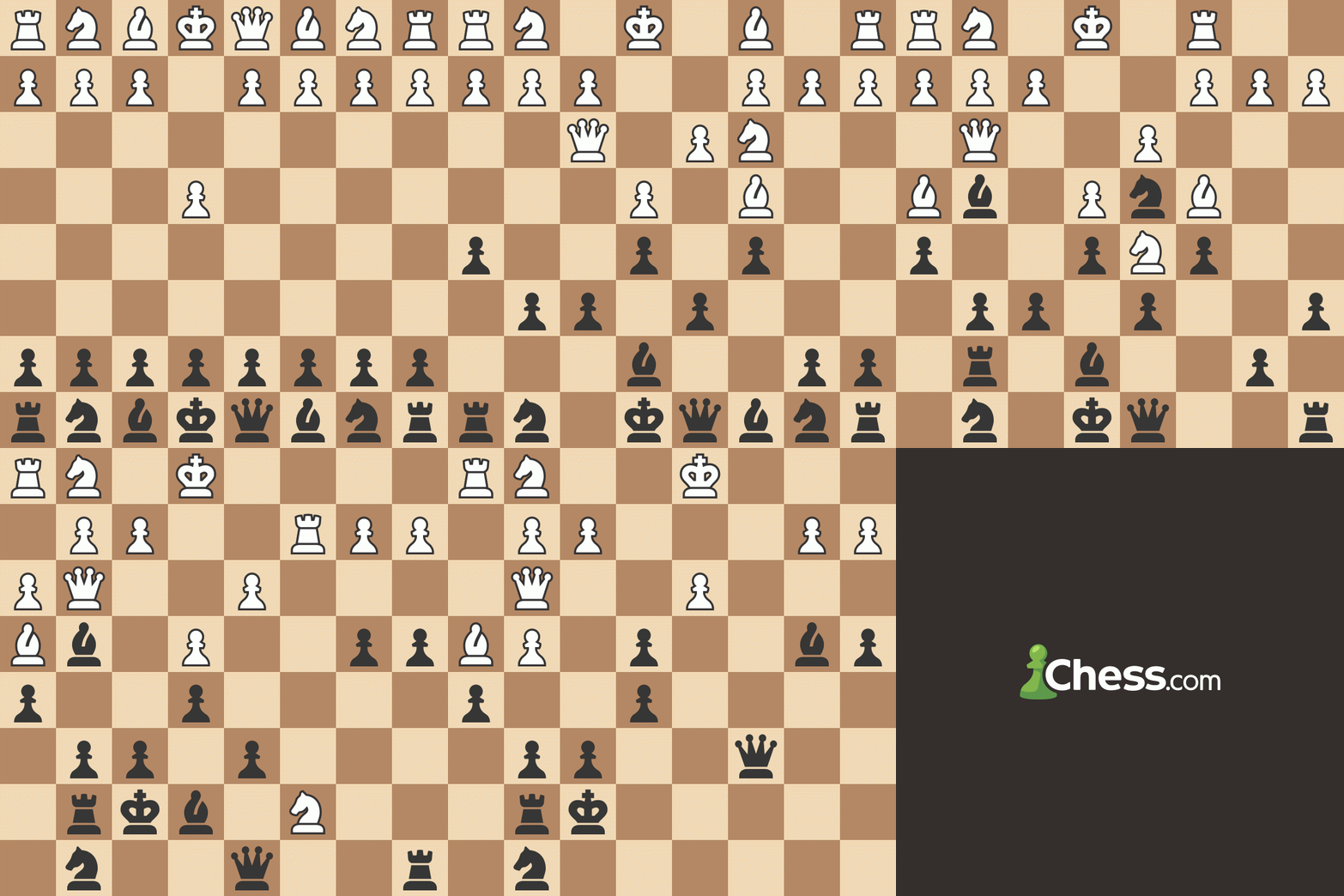
1. e4 e5
2. Qf3 f6
3. Bc4 Be7
4. Nc3 c5
5. Qh5+ g6
6. Qf3 h5
7. d3 d6
8. Bg5 Rh7
9. Bh4 Rg7
10. Bb5+ Nc6
11. Nd5 Bg4
12. Qg3 a6
13. Bc4 Nd4
14. Rc1 b5
15. Bb3 a5
16. c3 a4
17. Bc2 Nxc2+
18. Kd2 b4
19. cxb4 cxb4
20. Nc7+ Kf7
21. h3 b3
22. Nxa8 bxc2
23. Kxc2 Qa8+
24. Kd2 Qc6
25. hxg4 Bb4+
26. Kd1 dxe4
27. dxe4 Qxe4
28. Qe3 Qxg4+
29. f3 Qxg2
30. Rc7+ Ne7
31. Qxe5 Qd2# *
To be reviewed...
20260215_115300_white=burgerlabobo(570)-black=cbwarwade1812(561)
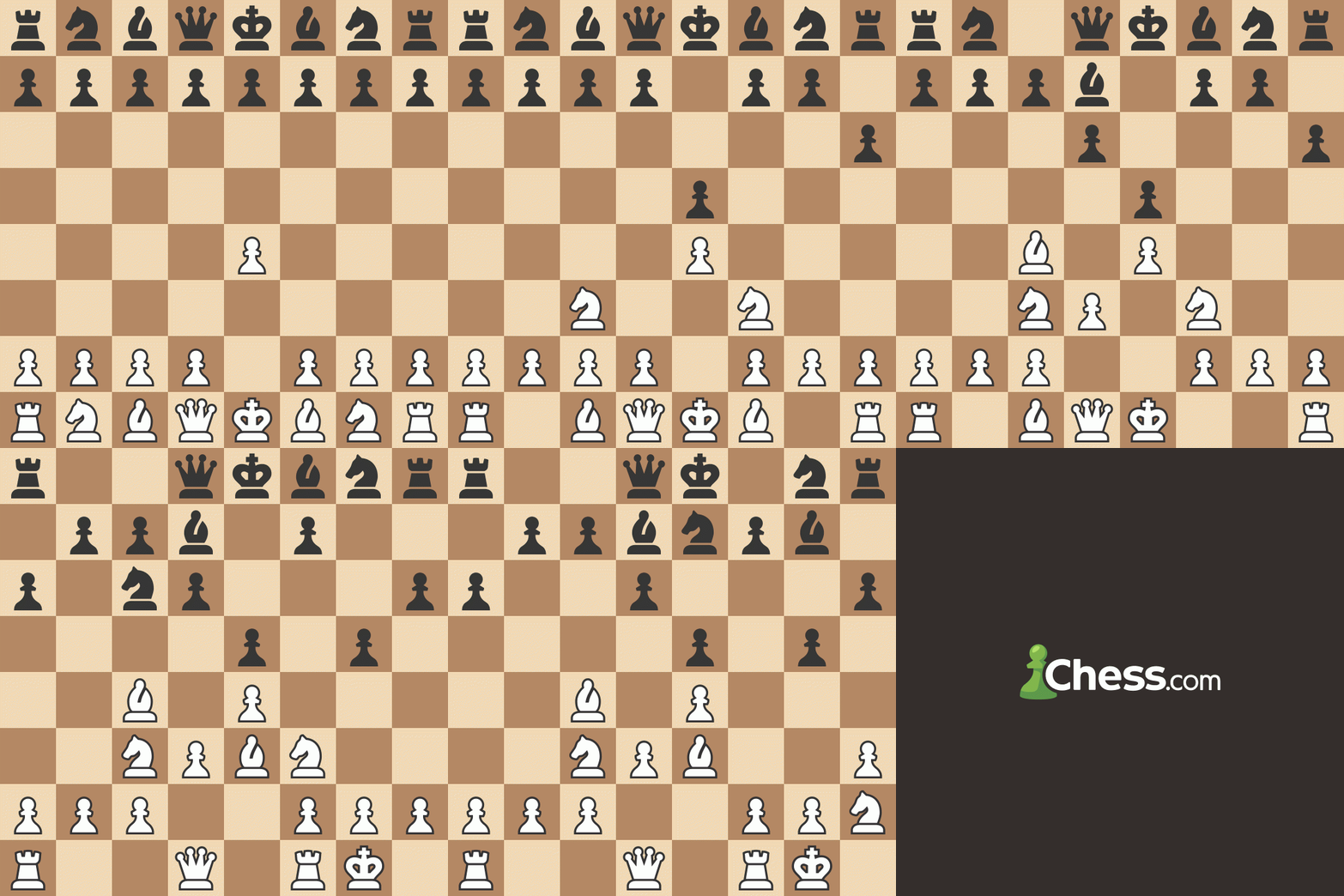
1. e4 e5
2. Nc3 h6
3. Nf3 d6
4. Bc4 Bd7
5. d3 Nc6
6. O-O a6
7. Be3 g5
8. h3 Bg7
9. Nh2 Nce7
10. Qf3 f6
11. Qh5+
Fastest win for me.
Opponent Black resigns after 11 moves, before any pieces are taken.
From White’s perspective.

## Opening
- *King’s Pawn* opening
- flexible development by White
  (Nc3, Nf3, Bc4, O-O, Be3, h3, Nh2, Qf3, Qh5+)
- Black plays several slow pawn moves
  (h6, d6, g5, a6, f6, Bg7, Nce7)
  which weaken the king side and
  fall behind in development.

## Move-by-move highlights (White)
- 1. e4: Strong central move, standard and good.
- 2. Nc3: Playable,
     but 2. Nf3 is more principled,
     attacking e5 immediately.
- 3. Nf3: Good development,
          pressures e5 and
          prepares castling.
- 4. Bc4: Active bishop, eyes f7;
          however Black can respond with solid development.
- 5. d3: Solid but a bit passive;
     d4 would fight for more space if tactically safe.
- 6. O-O: Excellent;
     king safety and rook to the center.
- 7. Be3: Logical development,
     connects rooks and supports the center;
     but it does block your c1 bishop’s diagonal for now.
- 8. h3: Useful prophylaxis against …Bg4 and …g4,
     but also slightly slow;
     you are still okay because Black is slower.
- 9. Nh2: A bit awkward;
     it moves a developed piece away from the center.
     A more active plan is Be3–d5, or Re1, or even d4.
- 10. Qf3: Centralizes the queen, targets f6/f7,
      and adds pressure to the kingside;
      reasonable given Black’s weaknesses.
- 11. Qh5+: The check uses Black’s weak dark squares
      and loosened kingside;
      you are clearly better
      after all of Black’s pawn moves.

## Black’s main problems
- Too many pawn moves (h6, g5, a6, f6)
  instead of developing pieces rapidly.
- Kingside seriously weakened by g5 and f6,
  giving you strong attacking chances
  with your queen and bishops.

## How White can improve
- In similar positions,
  prioritize *central control and development*
  before side moves
  (e.g., prefer 2. Nf3 and an early d4 when possible).
- Avoid retreating developed pieces (like Nh2)
  unless you have a concrete plan (e.g., Ng4 or f4).
  Try moves that increase central pressure instead
  (Re1, d4, Be3–d5).

Overall, you reached a promising attacking position
by move 11 thanks to safer development and
Black’s risky pawn advances.
20260214_203400_white=ilythia13-black=burgerlabobo(558)
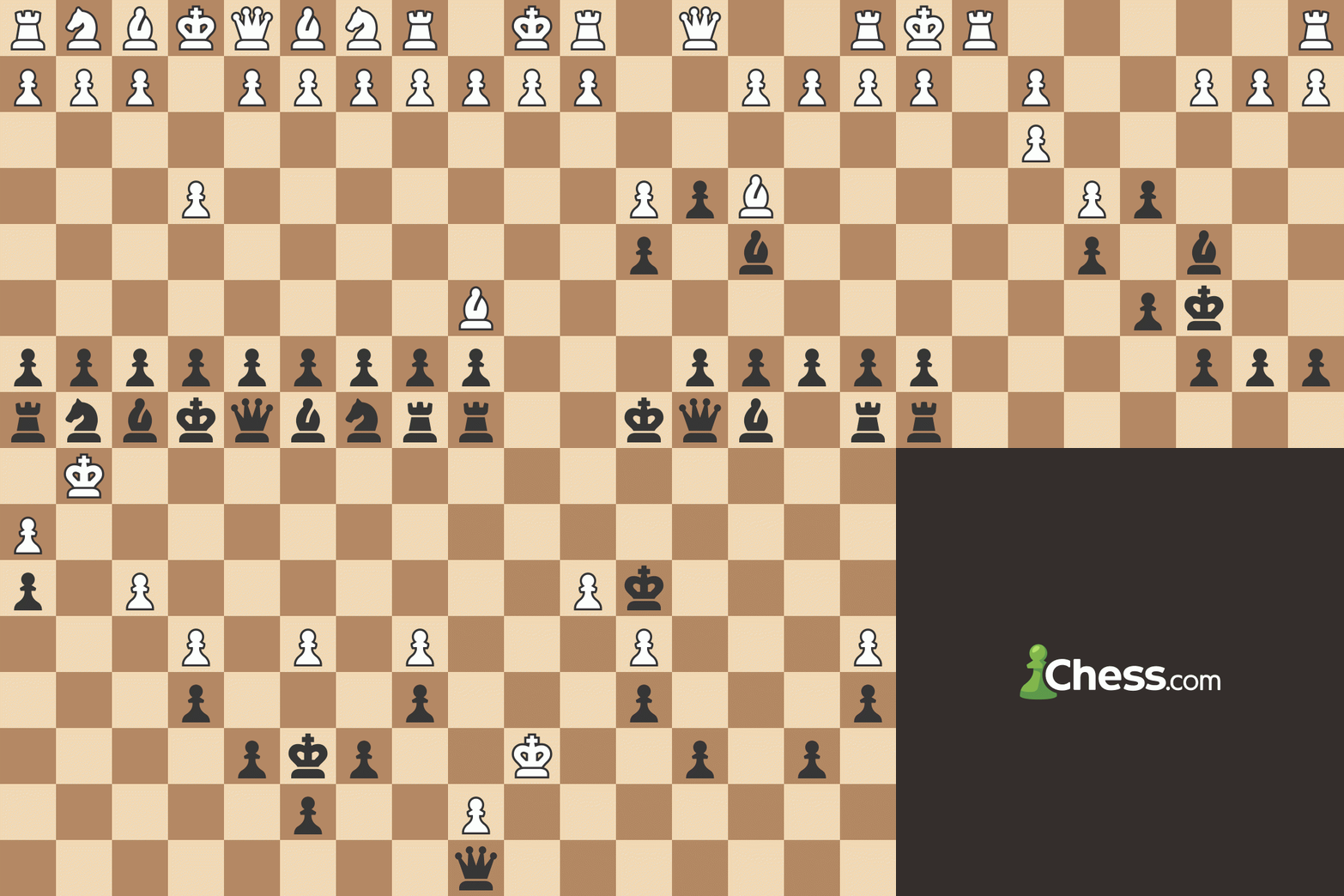
1. e4 e5
2. Nc3 Nc6
3. Nf3 Bc5
4. Bc4 Nh6
5. O-O Qf6
6. d4 exd4
7. Nd5 Qd8
8. Bg5 f6
9. Nxf6+ gxf6
10. Bxh6 Ne5
11. Nxe5 fxe5
12. Qg4 d6
13. Qh5+ Kd7
14. Bg5 Qf8
15. Qg4+ Kc6
16. Qf3 Qg7
17. Bf6 Qg8
18. Bxh8 Bg4
19. Bxg8 Bxf3
20. gxf3 Rxg8+
21. Kh1 Rxh8
22. Rg1 h5
23. a4 b6
24. c3 dxc3
25. bxc3 Bxf2
26. Rgf1 Bc5
27. c4 a5
28. Rfd1 h4
29. Rd5 Rg8
30. Rdd1 h3
31. Rg1 Rxg1+
32. Rxg1 Bxg1
33. Kxg1 Kc5
34. Kf2 Kxc4
35. Kg3 c5
36. Kxh3 Kd3
37. Kg4 c4
38. h4 c3
39. h5 c2
40. h6 c1=Q
41. h7 Qc8+
42. Kh5 Qh8
43. Kg6 Ke3
44. Kh6 Kxf3
45. Kg6 Kxe4
46. Kh6 d5
47. Kg6 d4
48. Kf7 d3
49. Ke6 d2
50. Kd6 d1=Q+
51. Ke6 Qxa4
52. Kd6 Qxh7
53. Ke6 Qc6#
0-1
You won a very dynamic attacking game
where White overextended and
you punished their king and piece play efficiently.

## Opening (moves 1–7)
- 1.e5 and 2.Nc6 are normal;
  3.Bc5 (Italian-style) OK,
    but better if after opponent moves Bc4.
    ie. Let white move bishop out, then counter.
  4.Nh6 = slow, loosens g5/f7.
    Nf6 = better
- 5.Qf6 = bad = develop queen too early
    d6  = better = pawn up to protect 4th row = safer
- 6.d4 exd4
  7.Nd5 Qd8 is OK,
  but you are already a bit behind in development and space.

If you want a cleaner game, prefer a mainline like:
1.e4 e5 2.Nf3 Nc6 3.Bc4 Bc5 4.c3 Nf6 or
4…Nf6 earlier, rather than the early …Nh6 and …Qf6.

## Early tactics (moves 8–15)
- 8.Bg5 f6 9.Nxf6+ gxf6 10.Bxh6 gives White a strong attack for the sacrificed piece; your kingside structure is shattered.
- 10…Ne5?! develops but doesn’t challenge White’s queen or bishop directly; a move like 10…Qe7 or 10…d6 with rapid castling queenside could be more resilient.
- After 12.Qg4 d6 13.Qh5+ Kd7 14.Bg5 Qf8 15.Qg4+ Kc6 your king walks into the centre, but in this game it actually works because White fails to hit precisely.

Here your position is objectively very risky: open g- and h-files, king in the middle, and White’s pieces very active.

## Turning point (moves 16–25)

- 16…Qg7 and 17…Qg8 show good defensive awareness, keeping queens on and guarding the dark squares around your king.
- 18.Bxh8 Bg4! is an excellent practical move, counterattacking and activating your bishop instead of passively defending material.
- 19…Bxf3! and 20…Rxg8+ trade off dangerous attacking pieces and coordinate your rooks on the g-file against White’s king.
- After 22…h5 23.a4 b6 24.c3 dxc3 25.bxc3 Bxf2 you’ve weathered the storm and are now clearly better: safer king, extra material, and strong central pawn majority.

The key strategic success: you did not cling to pawns; you prioritized piece activity (…Bg4, …Bxf3, …Rxg8) and exchanges that reduced White’s attack.

## Converting the advantage (moves 26–40)

- 26…Bc5 and 27…a5 restrict White’s queenside and prepare space for your king to come to the centre later.
- 28…h4 30…h3 is very good practical chess: you create a dangerous passed h-pawn and tie down White’s pieces.
- After 31…Rxg1+ 32.Rxg1 Bxg1 33.Kxg1 Kc5 34.Kf2 Kxc4 you reach a won endgame: extra material and a far-advanced passed h-pawn.
- 37…c4 38.h4 c3 39.h5 c2 40.h6 c1=Q shows excellent technique, pushing both passed pawns and forcing promotion despite White’s own passer.

This phase is played very cleanly; you bring the king actively (…Kc5, …Kc4, …Kd3) and coordinate pawns and king well.

## Endgame finish (moves 41–53)

- 41…Qc8+ 42.Kh5 Qxh7 simplifies into a queen vs king+pawns ending that is completely winning.
- From 46…d5 onwards you combine checks and pawn pushes methodically, forcing White’s king away from your passed pawns.
- 53…Qc6# is a nice final mating net using your central queen and advanced king.

### Practical takeaways for you (Black)

- Improve the opening: avoid early queen moves and …Nh6; aim for …Nf6, …d6, quick castling.
- When under attack, seek exchanges of attacking pieces and counterplay (your …Bg4 and …Bxf3 were model decisions).
- You handled the endgame **excellent**ly: active king, pushing connected or supported passers, and using the queen efficiently.

If you share another game where you use a more standard opening structure, I can help you refine your opening repertoire next.
20260213_180000_white=burgerlabobo(559)-black=joaoquinphoenix(539)
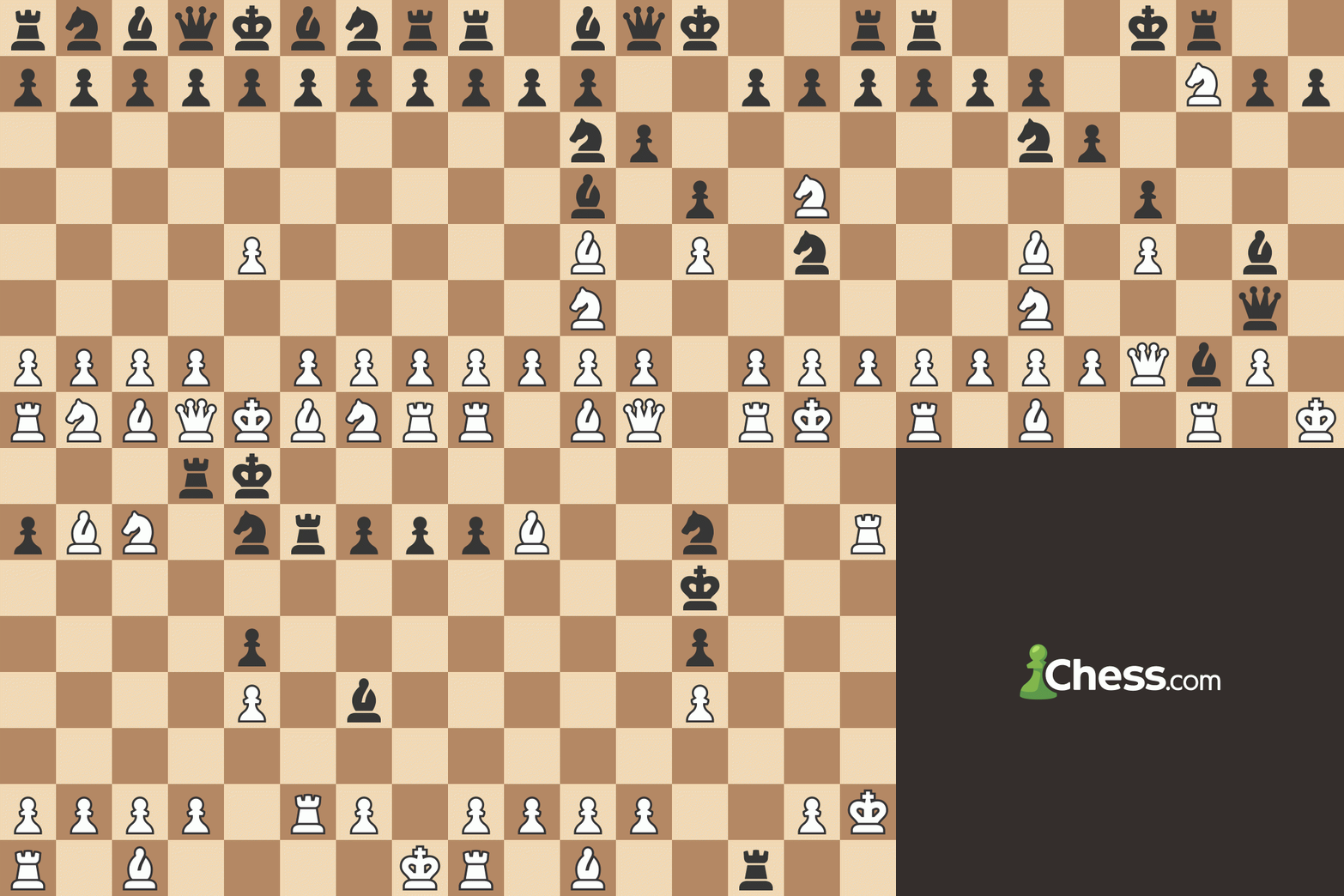
1. e4 e5
2. Nc3 Nc6
3. Bc4 Bc5
4. Nf3 d6
5. O-O Nf6
6. Ng5 Ng4
7. Nxf7 Qh4
8. h3 Bxf2+
9. Kh1 Qg3
10. hxg4 Rf8
11. Qe2 Bxg4
12. Qxf2 Qxf2
13. Rxf2 d5
14. Bxd5 Ne7
15. Bxb7 Rd8
16. Nb5 Rxf7
17. Nxc7+ Kd7
18. Rxf7 Be6
19. Nxe6 Kxe6
20. Rxg7 Rf8
21. Rxh7 Rf1+
22. Kh2 Kf6
23. Rh6+ Ng6
24. Rh5 Nf4
25. Rf5+ Kg6
26. Rxe5 Rf2
27. Kg3 1-0
Nice attacking game – you totally smashed Black’s king.

Clean things up in the opening
You played the “fried liver style” sacrifice with
6.Ng5 and 7.Nxf7, which is a known trap idea,
but here Black was actually fine if they knew theory.

Strong long‑term improvement for you:
instead of learning this sharp line first,
focus on calm development with moves like
d4, d3, Re1, h3
in similar Italian‑type positions
so you don’t rely on speculative sacrifices.

Where your opponent went wrong
The move 7…Qh4 followed by 8…Bxf2+ and 9…Qg3
allowed your king to run to h1 and
then your pawns and rooks chased Black’s queen side‑to‑side;
Black attacked without finishing development and
got punished.
Once you played Qxf2 and Rxf2,
you were simply up material
with their king stuck in the centre,
so the priority (which you followed well) is:
attack the king, open lines,
and keep bringing more pieces into the attack.

What you did very well
You kept checking and
opening lines against the king
(Nxc7+, Rxf7, Nxe6, Rxg7, Rxh7, Rh6+, Rh5, Rf5+, Rxe5).

You coordinated rooks and knight nicely:
the knight jumped in with tempo (Nxe6),
and the rooks hit along the f‑ and e‑files
to drag the king into the open.

You didn’t waste time grabbing random pawns;
you kept asking “where can I give another check?”
which is exactly right when the enemy king is exposed.

Concrete coaching takeaways
Opening:
for now, avoid early knight sacrifices like Nxf7
unless you’ve studied the exact line;
instead, prioritize development
(get all pieces out, castle, control the centre).

Middlegame:
when you are ahead in development
or their king is exposed,
do what you did here—open lines
(captures and pawn breaks) and
look for forcing moves (checks, threats with tempo).

Defensive skill:
also practice what to do
from Black’s side here
(castle early,
don’t bring the queen out too soon,
don’t attack if you’re behind in development);
flipping the board mentally
will help your overall understanding.